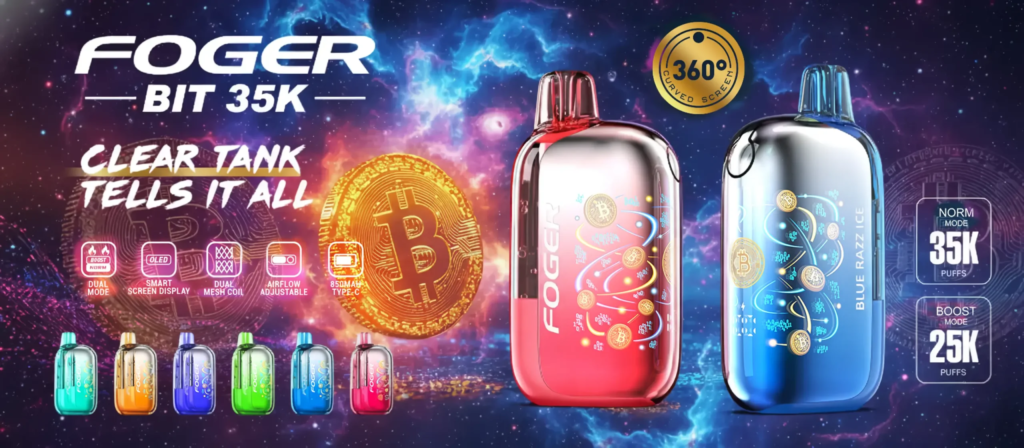

Ask anyone who works a vape shop counter what customers ask about first and you’ll get the same answer, and it isn’t battery size or puff count. It’s flavor. Hardware in the high-capacity segment has mostly converged, which means flavor design is where brands actually compete now. Fogger vape, a US brand known for devices like the Switch Pro 30K and the Bit 35K, makes a useful case study in how that competition plays out.
A range built in layers
Foger’s lineup splits into a few recognizable families. The first is plain-spoken fruit: single fruits or two-fruit pairings that do exactly what the label says. The second is the iced tier, where menthol or a cooling agent rides underneath the fruit. A third group drops literal description entirely and goes with invented names.
Blue Dragon sits in the middle ground. It’s a dragon fruit and berry blend, sweet up front with a mild cool finish, and the name at least gestures at what’s inside. Cool Mint holds down the opposite pole: no fruit, just mint and cold, the profile shops reorder because it never stops selling. Around those anchors the catalog covers candy profiles, beverage-style blends, and a few dessert leaning options.
None of this is revolutionary on paper. What’s notable is the discipline. Plenty of brands let their flavor lists sprawl until the names blur together and shop buyers can’t tell what to stock. Foger’s families are legible enough that a first-time customer can navigate them from the shelf tag alone.
When the name tells you nothing, on purpose
Meta Moon is the interesting case. The name describes nothing. The liquid is creamy and vaguely tropical, and regulars describe it to each other in noticeably different ways. That ambiguity looks deliberate. Abstract names have quietly become a pattern across the category, and the logic holds up: an invented name is ownable, it doesn’t box the liquid into a single expectation, and it gets customers comparing notes about what the flavor “actually is.” That conversation is free marketing.
There’s a second naming quirk worth flagging. The brand’s name reads as “fogger” to a lot of people, and search behavior reflects it: a meaningful share of shoppers type fogger flavors when they go looking for the lineup. The company keeps a full flavor list on its site, so both spellings land in the same place. It’s a small thing, but it says something about how brand names function in this market. People hear a name over a counter, or see it in a friend’s hand, and reconstruct the spelling later from memory.
New flavors arrive in waves
Foger’s release pattern is also worth a look. Instead of trickling out one flavor at a time, the brand ships additions in batches. This summer’s wave leaned into fruit-ice territory, several new profiles landing at once alongside the existing range.
Batch releases make practical sense at both ends of the supply chain. Shops get a reason to reset shelf space once instead of fielding a new SKU every few weeks. Returning customers walk in and find several new things to try in a single visit, which is a better retention mechanic than one novelty at a time. The trade-off is risk concentration. If a wave misses, it misses all at once.
What it adds up to
Flavor strategy in disposables used to mean copying whatever sold last quarter and renaming it. The brands pulling ahead now treat the flavor list as an actual product architecture: clear families for navigation, a few abstract names for identity, and release timing that gives retail a rhythm to work with.
Whether the current pace is sustainable across the category is an open question. Shelf space is finite, and shop buyers cull slow movers without sentiment. For now, Foger is worth watching as an example of how a mid-size player uses flavor design, naming, and timing to hold attention in a crowded segment.